Non-aqueous carbon black suspensions for lithium-based redox flow batteries: rheology and simultaneous rheo-electrical behavior.
Jun 7, 2013· ,,,,·
0 min read
,,,,·
0 min read
Mohamed Youssry
Lénaïc Madec
Patrick Soudan
Manuella Cerbelaud
Dominique Guyomard
Bernard Lestriez
Abstract
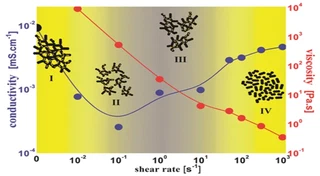
We report on the rheological and electrical properties of non-aqueous carbon black (CB) suspensions at equilibrium and under steady shear flow. The smaller the primary particle size of carbon black is, the higher the magnitude of rheological parameters and the conductivity are. The electrical percolation threshold ranges seem to coincide with the strong gel rather than the weak gel rheological threshold ones. The simultaneous measurements of electrical properties under shear flow reveal the well-known breaking-and-reforming mechanism that characterises such complex fluids. The small shear rate breaks up the network into smaller agglomerates, which in turn transform into anisometric eroded ones at very high shear rates, recovering the network conductivity. The type of carbon black, its concentration range and the flow rate range are now precisely identified for optimizing the performance of a redox flow battery. A preliminary electrochemical study for a composite anolyte (CB/Li4Ti5O12) at different charge-discharge rates and thicknesses is shown.
Type
Publication
Physical chemistry chemical physics : PCCP
