Cobalt and Nickel Nanocatalysts Confined inside Halloysite Nanotubes for Selective Hydrogenations
Sep 4, 2024·, ,,,·
0 min read
,,,·
0 min read
Alejandro Serrano-Maldonado
Jean-Bernard Ledeuil
Lénaïc Madec
Romain Rodrigues
Daniel Pla
Montserrat Gómez
Abstract
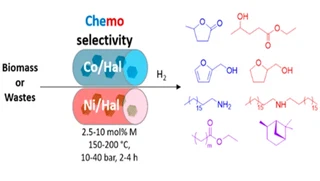
Innovative cobalt and nickel catalytic materials containing metal nanoparticles immobilized into the inner tubes of pristine halloysite, a naturally occurring nanoclay, and their application in hydrogenation reactions of a large variety of substrates from biomass and industrial wastes are described herein. The catalytic materials with a high metal loading (>24 wt %) were prepared by a one-pot two-step procedure in the absence of additional stabilizers, leading to metal nanoparticles essentially confined into the support lumen (constituted of aggregates of small nanoparticles) as a result of the privileged electrostatic interactions between aluminols and metal acetate salts [Ni(OAc)2 and Co(OAc)2]. Both catalytic materials, Ni/Hal and Co/Hal, gave different chemoselectivities toward the reduction of unsaturated functional groups (carbonyl, CC, and nitrile) under solvent-free conditions, thus affording selectively value-added compounds depending on the nature of the metal. In particular, the squalene hydrogenation monitoring permitted identification of the partial hydrogenated products and estimation of the partial turnover numbers and frequencies, achieving a cumulative TON of 110 and TOF of 151 h–1 using the most active catalytic system, i.e., Ni/Hal.
Type
Publication
ACS Applied Nano Materials
