The role of prop-1-ene-1,3-sultone as an additive in lithium-ion cells
Aug 29, 2015·, ,·
0 min read
,·
0 min read
Julian Self
David S. Hall
Lénaïc Madec
Jeff R. Dahn
Abstract
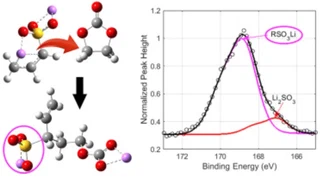
Density functional theory (DFT) is used in conjunction with experimental results to propose decomposition pathways that describe the role and ultimate fate of the PES additive in Li-ion batteries. Oxidation of PES produces carbonyl sulfide gas and ethene at the positive electrode, both experimentally observed byproducts. However, the calculated standard potential for simple PES oxidation, E0ox ??? 6.7 V vs. Li/Li+, is quite high, suggesting this pathway is unlikely. A "reactive electrode model" is presented, in which the positive electrode material is a reagent in the pseudo-combustion of PES (and other solvents). This spontaneous process produces carbonyl sulfide, carbon dioxide, and a rock salt surface layer, all of which are experimentally observed. At the negative electrode, the reduction of PES occurs via two one-electron steps, where E0red,1= 0.9 V and E0red,2= 4.3 V. The reduced species, Li 2 PES, can react with hydrogen and methyl radicals to produce propene, methylpropene, propane and lithium sulfite. Nucleophilic Li 2 PES can also react with electrophilic PES, ethylene carbonate, or ethyl methyl carbonate. Eighteen possible organic sulphate ‘building blocks’ for the solid-electrolyte interphase (SEI) are presented. X-ray photoelectron spectroscopy (XPS) measurements demonstrate that PES reduction indeed results in both lithium sulfite and organic sulphate SEI components.
Type
Publication
Journal of Power Sources
