Cross-Section Auger/XPS Imaging of Conversion Type Electrodes: How Their Morphological Evolution Controls the Performance in Li-Ion Batteries
Jun 22, 2019· ,,,,·
0 min read
,,,,·
0 min read
Lénaïc Madec
Jean Bernard Ledeuil
Gaël Coquil
Laure Monconduit
Hervé Martinez
Abstract
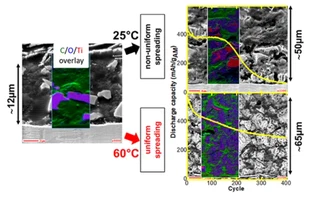
Conversion type reactions have revolutionized the field of Li-ion batteries and beyond in terms of electrochemical performance and fundamental aspects. However, direct evidence of this reaction over long-term cycling still has to be demonstrated. Indeed, investigating the morphological conversion mechanism at both the electrode and nanometer scales remains very challenging. Here, the use of advanced Auger/μXPS imaging of electrode cross-sections, prepared by ion-milling, is proposed. Through the study of TiSnSb-based electrodes, the role of the inactive element (here Ti) in the long-term reversibility of the conversion reaction is highlighted. Importantly, Ti, Sn, and Sb are found together at the nanometer scale despite a total spreading over tens of microns which directly proves the electrochemical conversion of the TiSnSb material even after 400 cycles. Moreover, a gradual shell to core expansion/break-up of TiSnSb particles is revealed during the continuous conversion reactions and leads to highly porous structures after 400 cycles. This phenomenon, more uniform at 60 °C, is at the origin of the higher electrochemical performance at this temperature. Overall, the innovative approach proposed in this work will benefit the the study of not only conversion/alloy-based batteries but also all-solid-state batteries for which buried interfaces have to be reached.
Type
Publication
ACS Applied Energy Materials
