Paving the Way for K-Ion Batteries: Role of Electrolyte Reactivity through the Example of Sb-Based Electrodes
Sep 28, 2018· ,,,,,·
0 min read
,,,,,·
0 min read
Lénaïc Madec
Vincent Gabaudan
Grégory Gachot
Lorenzo Stievano
Laure Monconduit
Hervé Martinez
Abstract
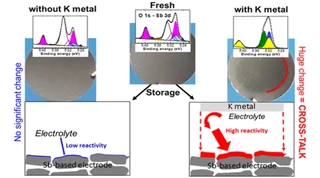
Developing potassium-ion batteries remains a challenge so far due to the lack of efficient electrolytes. Moreover, the high reactivity of K metal and the use of half-cells may greatly alter both the electrochemical performance and the solid electrolyte interphase formation. Here, it is shown that in K metal/Sb half-cells, Coulombic efficiency improvement is achieved by the addition of fluoroethylene carbonate + vinylene carbonate to propylene carbonate (PC), the replacement of PC by ethylene carbonate/diethyl carbonate, and the replacement of KPF6 by potassium bis(fluorosulfonyl)imide. Surprisingly, however, storage of cells containing K metal leads to the coloration of K metal, separators, and Sb electrodes, whereas no change occurs for cells prepared without K metal. These results demonstrate that for all electrolytes, the high electrolyte reactivity with K metal also influences the Sb/electrolyte interface via a cross-talk mechanism. This observation is supported by gas chromatography/mass spectrometry analysis of electrolytes and X-ray photoelectron spectroscopy analysis of Sb electrodes. In summary, these results indicate that the search for efficient electrolytes for potassium-ion batteries must be carried out in full cells if one wants to obtain meaningful correlations between electrochemical performance and electrode/electrolyte interfacial properties. Overall, the results presented here are also likely to benefit the development of other emerging Na- and Mg-ion cell chemistries.
Type
Publication
ACS Applied Materials and Interfaces
