Impact of the metal electrode size in half-cells studies: Example of graphite/Li coin cells

Abstract
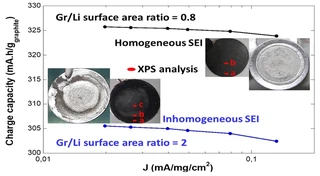
When half-cells are used to evaluate and understand electrochemical performance and interface properties of a given electrode, the metal electrode size is rarely mentioned. To evaluate such impact on the electrochemical performance and interphase formation, graphite/Li coin cells were used. Undersizing the Li metal electrode led to significantly lower charge/discharge capacities even at C/20 rate due to incomplete lithiation/delithiation processes of the graphite electrode edge. It also led to the formation of non-uniform Li metal deposits as well as to a graphite SEI film with a thickness and composition gradient across the electrode. Oversized Li led, however to homogeneous graphite SEI film. Overall, these results highlight the critical role of the metal electrode size in half-cells and should apply to all half-cells studies using other metal electrodes such as Na, K, Mg.
Type
Publication
Electrochemistry Communications
