In situ redox functionalization of composite electrodes for high power-high energy electrochemical storage systems via a non-covalent approach
Dec 2, 2011· ,,,,,,,·
0 min read
,,,,,,,·
0 min read
Lénaïc Madec
Audrey Bouvrée
Philippe Blanchard
Charles Cougnon
Thierry Brousse
Bernard Lestriez
Dominique Guyomard
Joël Gaubicher
Abstract
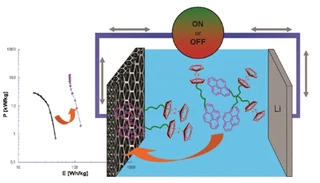
The growing demand for new global resources of clean and sustainable energy emerges as the greatest challenge in today’s society. For numerous applications such as hybrid vehicles, electrochemical storage systems simultaneously require high energy and high power. For this reason, intensive researches focus on proposing alternative devices to conventional Li battery and supercapacitors. Here, we report a proof of concept based on non-covalent redox functionalization of composite electrodes that may occur either during the calendar life or during the device functioning. The active material, a multi-redox pyrene derivative, is initially contained in the electrolyte. No additional benchmarking step is therefore required, and it can, in principle, be readily applied to any type of composite electrode (supercapacitors, battery, semi-solid flow cell etc.). Accordingly, a practical carbon fiber electrode that is 10 mg cm(-2) loaded can deliver up to 130 kW kg(electrode)(-1) and 130 Wh kg(electrode)(-1) with negligible capacity loss over the first 60 000 charge/discharge cycles.
Type
Publication
Energy & Environmental Science
