Novel nanoporous MnOx (x=∼1.75) sorbent for the removal of SO2 and NH3 made from MnC2O4·2H2O
Mar 1, 2016·, ,,,·
0 min read
,,,·
0 min read
Xiaowei Ma
Nicholas Campbell
Lénaïc Madec
Matthew A. Rankin
Lisa M. Croll
Jeff R. Dahn
Abstract
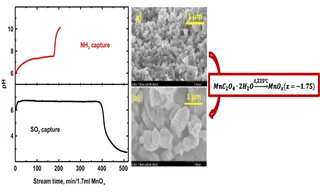
In this work, nanoporous manganese oxides (MnOx) were prepared by thermal decomposition of MnC2O4·2H2O at 225°C for 6h in air. The manganese oxalate dihydrate precipitate was made from manganese sulfate and ammonium oxalate during ultrasonication and stirring. The physical properties of the oxalate precursors and the resulting MnOx samples were characterized with SEM, TGA-DSC, FTIR and powder XRD. The specific surface areas and porosity of MnOx were studied by single-point BET and multi-point N2 adsorption-desorption measurements. The amorphous MnOx from oxalate prepared by sonication showed a specific surface area as large as 499.7 m2/g. Dynamic SO2 and NH3 flow tests indicated that the adsorption capacity of MnOx, especially for SO2, can be increased by increased surface area. Compared to the best Mn3O4-impregnated activated carbon adsorbent, nanoporous MnOx could remove approximately three times as much SO2 and a comparable amount of NH3 per gram of adsorbent. This could lead to respirators of lower weight and smaller size which will be attractive to users.
Type
Publication
Journal of Colloid and Interface Science
