A novel K-ion KVPO4F0.5O0.5/graphite full cell: Correlation between XPS SEI studies and electrochemical testing results

Abstract
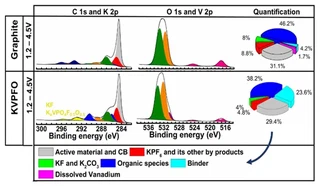
Like li- and Na-ion batteries, electrolyte reactivity (i.e., salt and solvent decomposition) is important in the electrochemical performance of K-ion batteries (KIBs). Indeed, X-ray photoelectron spectroscopy (XPS) analysis of a solid electrolyte interphase (SEI) in KIBs is still based on K-ion half-cells. This may lead to incorrect interpretations of the results considering the contamination of the studied electrode SEI due to the high K metal reactivity. Therefore, this study aims to provide a reliable XPS study without potassium metal, investigating the impact of various parameters, including open-circuit voltage (OCV) temperature, upper cut-off voltage (UCV), depth of discharge (DOD), and vanadium dissolution, on the electrochemical performance of KVPO4F0.5O0.5/graphite full cells. This work highlights the importance of SEI preformation, which is more pronounced at higher OCV temperatures. At specific UCV and DOD, the cell provides the best trade-off between the organic and inorganic passivation layer, leading to good electrochemical performance. The study also demonstrates that vanadium dissolution is a potential mechanism affecting capacity fading in K-ion batteries. Finally, understanding these SEI growth mechanisms should help researchers get reliable XPS analysis of the SEI in KIBs and move forward with the practical passivation layer characterizations.
Type
Publication
Journal of Power Sources
