Optimized electrode formulation for enhanced performance of graphite in K-ion batteries

Abstract
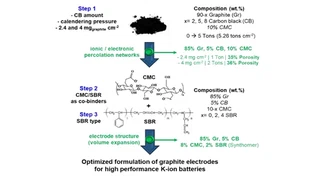
Potassium ion batteries (KIBs) are emerging notably due to the reversible K+ intercalation into graphite. So far, optimization of graphite electrode formulation remains, however, to be investigated. This work thus proposes to optimize ionic (porosity) and electronic percolation networks as well as mechanical properties of graphite electrodes for KIBs. To do so, carbon black amount (CB) and electrode calendering is first adjusted. Then carboxylated styrene butadiene rubber (SBR) is used, with different amount and functional groups contents, as co-binder with carboxymethyl cellulose (CMC–Na). The best electrodes, made of 95/5/8/2 wt.% of graphite(SLP30)/CB(C65)/CMC–Na/SBR(Synthomer) with 2.4 mgcm−2 loading and 35% porosity, deliver ∼250 mAhg−1 during depotassiation at 5C with only ∼0.3 V polarization and 205 mAhg−1 during potassiation at 1C (3-electrodes configuration). In addition, no capacity loss is observed after 55 cycles at C/5 potassiation/1C depotassiation due to a low electrode volume expansion (11%) compared to 24% without SBR after only 35 cycles. These results highlight that appropriate SBR significantly improves the electrode structure/cohesion/elasticity (i.e. volume expansion management), leading to better power performance and capacity retention of graphite electrodes for KIBs. Finally, considering that further improvements are expected by tuning electrolyte formulation, this work will benefit to the development of high energy KIBs.
Type
Publication
Electrochimica Acta
