Impact of Graphite Properties and Electrode Formulation on Potassium-Ion Battery Performance and Storage Mechanisms
Oct 30, 2025·,, ,,,,,·
0 min read
,,,,,·
0 min read
Louiza Larbi
Badre Larhrib
Jean-Marc Le Meins
Lénaïc Madec
Bernard Fraisse
Julien Fullenwarth
Simon Gree
Laure Monconduit
Camelia Matei Ghimbeu
Abstract
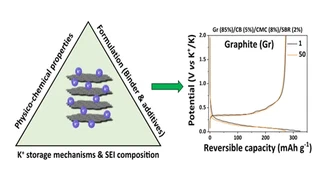
Graphite is a promising negative electrode material for potassium-ion batteries (KIBs). However, the precise role of graphite properties and electrode formulation on performance remains poorly understood, as do the K-ion storage mechanisms. Herein, four graphite materials with different particle sizes (6 to 50 μm) and distinct properties, as well as three electrode formulations, were investigated. The materials with both intermediate particle size and low specific surface area, O-content, and defects exhibited the best performance. They combined fast K+ diffusion with limited solid electrolyte interphase (SEI) formation, as shown by post-mortem X-ray photoelectron spectroscopy (XPS). Additionally, the electrodes formulated with Na-carboxymethyl cellulose/styrene-butadiene rubber (CMC/SBR) as binders delivered the best reversible capacity (273 mAhg–1), the highest initial Coulombic efficiency (ICE) (84%), and capacity retention (100%/50 cycles) at C/10 (27.9 mAg–1), compared to polyvinylidene fluoride (PVDF)-based electrodes. Ex situ and operando X-ray diffraction (XRD) studies revealed that K+ intercalation in graphite follows a four-stage mechanism, involving sequential formation of potassium-graphite intercalation compounds (K-GICs: KC48 → KC36 → KC24 → KC8), with structural modifications occurring after K+ extraction. Furthermore, the mechanisms of self-depotassiation were studied for the first time and showed that the KC8 phase (stage 1) does not form during potassiation, despite being thermodynamically predicted. During depotassiation, both self-discharge and electrochemical discharge processes produced similar intermediate GICs; however, self-discharge exhibited significantly slower reaction kinetics.
Type
Publication
ACS Applied Energy Materials
