Impact of the salts and solvents on the SEI formation in Sb/Na batteries: An XPS analysis
Apr 30, 2016·, ,,·
0 min read
,,·
0 min read
Ali Darwiche
Lucille Bodenes
Lénaïc Madec
Laure Monconduit
Hervé Martinez
Abstract
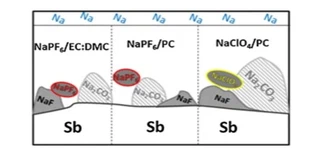
A thorough X-ray photoelectron spectroscopy (XPS) is carried out on the Sb/Na electrochemical cell to rationalize the different electrochemical performances in terms of irreversible capacity on first cycle, cumulated capacity losses, reversible capacity and capacity retention. Surface analysis of Sb electrode cycled versus sodium using three different electrolyte formulations by changing the nature of the salt (NaClO4 or NaPF6) and the nature of the solvents (PC or EC/DMC mixture) was performed by a combined XPS core peaks and quantification data analysis to establish the main components of the solid electrolyte interphase film (SEI) and its evolution on cycling. The passivation layer formed during cycling is mainly constituted of carbonates, Na2CO3 and alkylcarbonates, that appear during the discharge after the preferential deposition of NaF from the degradation of FEC. The solvent appears to have a key role, and the NaClO4/PC electrolyte, despite the high viscosity of its solvent gives the best compromise in terms of performances by forming a stable and thick SEI at the surface of all components of the composite electrode.
Type
Publication
Electrochimica Acta
