Advanced Nickel-Based Catalytic Materials on Hydroxyapatite: Effect of the Metal Particle Size on Tri-reforming of Methane
Feb 23, 2024·,, ,,,·
0 min read
,,,·
0 min read
Alejandro Pérez Alonso
Alejandro Serrano-Maldonado
Jean-Bernard Ledeuil
Lénaïc Madec
Doan Pham Minh
Daniel Pla
Montserrat Gómez
Abstract
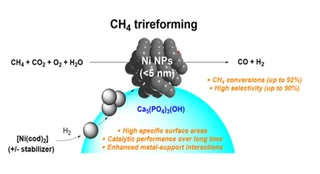
A new strategy based on an organometallic approach for the preparation of Ni-based catalytic materials permitting control of the morphology and distribution of the nanoparticles on the support has been developed, leading to spherical, small (mean diameter below 5 nm), and homogeneously distributed nickel nanoparticles on hydroxyapatite. The as-prepared materials were characterized by different techniques (N2 physisorption, powder X-ray diffraction, transmission electron microscopy, infrared spectroscopy, temperature-programmed reduction, temperature-programmed desorption of ammonia, temperature-programmed desorption of carbon dioxide, and thermogravimetric analyses, among the most relevant). The catalytic performance of these materials was evaluated in the tri-reforming of methane at 800–850°C and 1.4 bar (molar feed composition CH4:CO2:H2O:O2 = 63.3:30.7:0.04:5.95, gas hourly space velocity = 14.9 L·gcat–1·h–1), in view of syngas production. Outstanding catalytic performance, in terms of activity, selectivity, and stability, were achieved with the catalysts prepared via an organometallic method precluding structural modifications on the support. A comparative study between these catalytic materials proved higher activity and stability of the aforementioned materials in comparison with those prepared by a conventional incipient wetness impregnation methodology, mainly associated with stronger metal support interactions and higher surface area.
Type
Publication
ACS Sustainable Resource Management
