Nickel Nanoparticles Immobilized on Pristine Halloysite: An Outstanding Catalyst for Hydrogenation Processes
Sep 6, 2022·,, ,,,·
0 min read
,,,·
0 min read
Alejandro Pérez Alonso
Steven Mauriés
Jean‐Bernard Ledeuil
Lénaïc Madec
Doan Pham Minh
Daniel Pla
Montserrat Gómez
Abstract
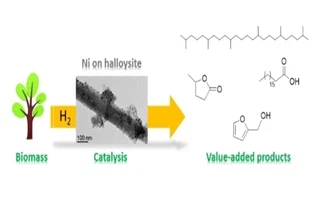
Nickel nanoparticles (NiNPs) immobilized on halloysite‐based supports were straightforwardly synthesized and fully characterized by different techniques with the purpose of evaluating the catalytic performance of these as‐prepared composite materials as catalysts in hydrogenation reactions. Thus, halloysite bearing amino (HAL‐NH 2 ) and ammonium (HAL‐NEt 3 ) groups led to less active catalytic materials in comparison with unfunctionalized halloysite supports, probably due to relative strong metal‐support interactions with amino and tetraalkylammonium functions, consequently hindering the interaction of unsaturated substrates at the surface of the catalytic material. Despite NiNPs supported on pristine halloysite provided merely agglomerates, NiNPs stabilized by quinidine on unfunctionalized halloysite ( NiC ) proved to be a highly effective and versatile catalyst operating at relative low temperature (25–100°C) and metal loading (1–20 mol %Ni), very well‐adapted to reduce a large range of functions (alkenes, alkynes, ketones, aldehydes, nitro…). Moreover, NiC was able to selectively reduce substrates from biomass to yield high value‐added products, such as squalane, saturated fatty acids, furfuryl alcohol and γ‐valerolactone.
Type
Publication
ChemCatChem
